Whilst editing my footage I wanted to look at different possible transitions between cuts which would look best and would suit the pace and theme of my documentary. So that I could demonstrate what each transition looked like I used a screen recorder, this recorded my screen as I played each transition and you can see these videos below.
The first transition I used was a cross blur (as seen below), I was't too keen on this as I felt it didn't flow with the music too well.
The next transition I used is a cross dissolve (see below), I preferred this transition as it fitted really well with the background music and the pace of the footage.
The final transition I used was a cross zoom (see below), I also like this transition but only between specific cuts as it is quite a fast transition and only looks right at certain points.
Wednesday, 4 October 2017

Tuesday, 3 October 2017
PRODUCTION: Testing my Music
I wanted to see which of the soundtracks that I found suited the opening of my documentary best, you can see from the screenshots below where I have been trying out each piece of music.  |
| Using Live the Moment Music |
 |
| Using Midnight City Music |
 |
| Using No Time for Games Music |
 |
| Using Triumphant Classical Piano Music |
 |
| Using Virgo Music |
From listening to each piece of music with the opening of my documentary I was able to find which one suited the pace of the footage best. The music which worked best was 'No Time for Games' so I will use this piece for the opening.
Monday, 2 October 2017
RESEARCH: Background Music
At first I was unsure of where I would be able to find background music to use for my documentary, so I decided to do some research to find various pieces which I would be able to use. I knew that my documentary would need a fairly upbeat instrumental backtrack as the theme of it is quite light and enjoyable. So, I started researching into upbeat background music and I came across audio blocks.

Audio blocks is a website where you can listen to the backing tracks for free but you cannot download them. However I have found a way around this as you can look up the music titles and free downloads come up, I can also find them on you tube where I will then be able to convert them into MP3 files. For example, the 'live the moment' track I could find on you tube. Link to 'live the moment' soundtrack.


Here is a list of the backing tracks which I liked best and would like to use in my documentary:
1. 'Live the Moment' by Mikael Manvelyan, link here.
2. 'Midnight City' by Mikael Manvelyan, link here.
3. 'Triumphant Classical Piano' by Bobby Cole, link here.
4. 'No Time for Games' by Neil Cross, link here.
5. 'Virgo' by Mikael Manvelyan, link here.
Saturday, 30 September 2017


Friday, 29 September 2017
RESEARCH: Designer Brand Reputations
In my research I started to think about how big designer
luxury labels have their exclusivity filtered down when ordinary people buy the
brands. For instance I found this interesting article about soap star Danniella
Westbrook wearing head to toe Burberry.

Wednesday, 27 September 2017
RESEARCH: Stuart Hall

Stuart Hall is a Cultural Theorist who looked at the role of audience positioning. He came up with a model which suggested three different ways which an audience can interpret a media text, these include; a preferred reading, a negotiated reading and an oppositional reading.
A preferred reading is when the audience interprets a text in the way which the author intended. In my documentary I intend the audience to interpret fashion and designer clothes to be a positive thing and something which people use to express their individuality.
A negotiated reading is where they mostly accept the preferred reading but sometimes changes it slightly due to personal experiences and interests. A negotiated reading which may be interpreted from my documentary is that the audience can see where designer goods can aid people to express their individuality but they don't agree on spending ridiculous amounts of money to do that. You could easily express your individuality by buying normal high street clothes too.
An oppositional reading is where the audience completely rejects the authors preferred reading due to their social place. An oppositional reading which could come from my documentary is that someone finds designer clothes to be a very negative part of the retail world as it separates society and creates an unfair hierarchy which is dependant on how much money an individual has and can spend on clothing items.
Tuesday, 26 September 2017
Monday, 25 September 2017
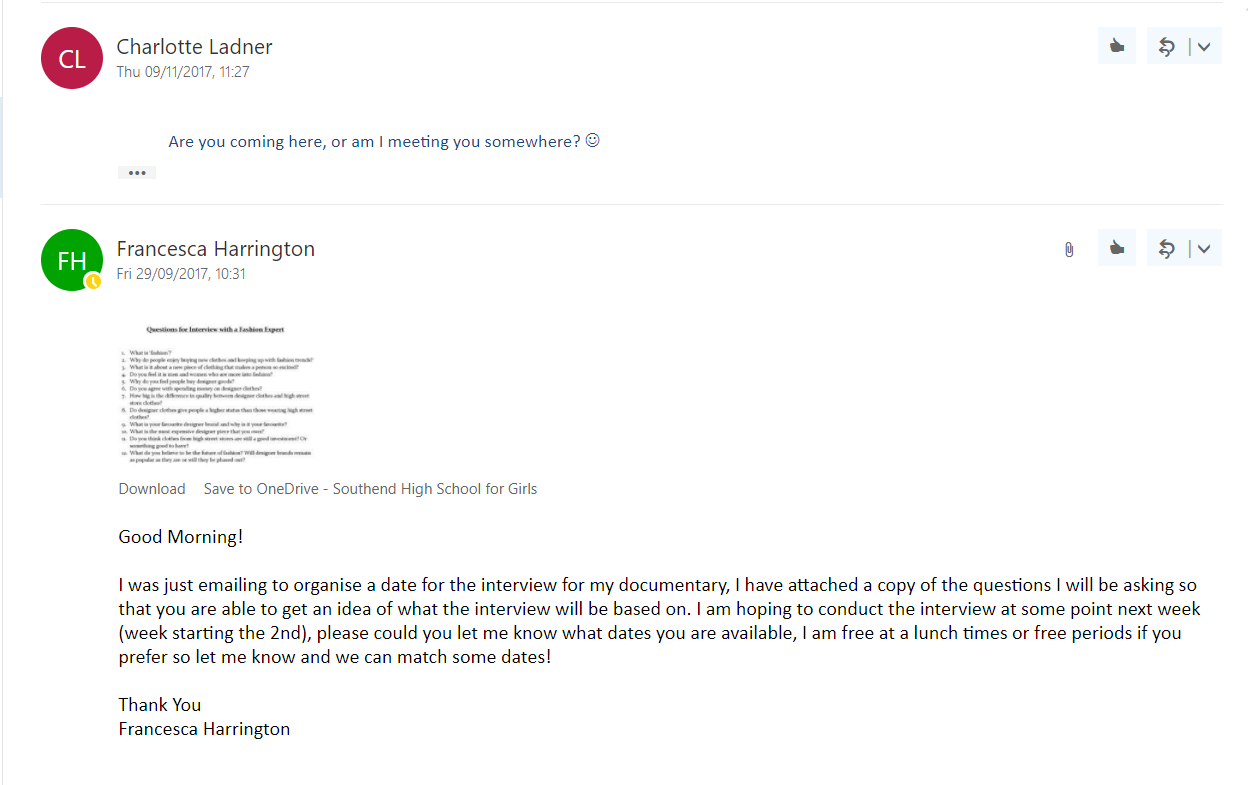
PLANNING: Planning Questions for my Interviews
I will be conducting 2 interviews now instead of one, at first I believed one interview to be enough but since researching into documentaries I have found there is a minimum of two different interviews. Therefore I planned to conduct two interviews, one with a Fashion Expert and one with a Psychologist. Before I conducted these interviews I needed to plan what questions I would be asking my experts which can be seen below:


I have made sure my questions were all open questions as this will allow for discussion during the interview, therefore I would be able to draw out as much information as possible from my interviews.
Friday, 22 September 2017
RESEARCH: Statistics & Facts

As I was researching for statistics of spending habits within the fashion industry I found this interesting article. This article has really good statistics which I would be able to use in my documentary such as:
1. The average British woman will spend over half a million pounds on fashion over their lifetime.
2. The British fashion industry is worth £26 billion to the economy.
3. Women between the ages of 30 and 45 spend on average £1,200 on fashion items per month.
4. There are 3 categories of 'Wardrobe Wealth'. Category 1 - 'The major must have's', this includes pieces which are hot right now but will soon go out of fashion. Category 2 - 'Contemporary Classics', designer items which retain their value, designer pieces you would wear to work, the investment into timeless pieces. Category 3 - 'Lifetime Luxuries', designer items which will rise in value over time e.g. a classic quilted Chanel handbag .
I also found out from this article that a website called covetique.com had been set up where you could buy or sell designer clothes from other people, unfortunately this site has now shut down.
As I continued with my research I looked at comparisons of the annual revenues of high street vs designer brands, here is what I found:
Designers...
*Chanel - 5.2 billion USD
*Louis Vuitton - 10 billion USD
*Cartier - 6.1 billion USD
*Burberry - 2.515 billion USD
High Street...
*ASOS - 1.158 billion USD
*New Look - 1.528 billion USD
*River Island - 925.8 million USD
*H.Samuel - 3.665 billion USD


My documentary is based on the reasons behind why people buy and wear designer brands, so I wanted to find some facts on this, I found 2 articles on this. One from the guardian and one from college candy, these articles had opposing opinions of designer brands, one for (college candy) and one against (the Guardian), below are some interesting points I have taken from these articles:
The Guardian...
1. They are brand snobs and think flaunting the name of he shop where they bought their clothes makes them cool.
2. People who wear designer brands fail to see that they are being used by the brand as a form of free advertising.
3. They are paying more money for clothes just to be an advertisement.
College Candy...
1. Product quality is much better than the quality of high street store clothes, they use better materials and stitching.
2. Consistency within brands, people end up swearing by one designer and staying committed to that one brand.
3. Different designers give their own certain representations, they can give their consumers an identity and can represent who they are.
4. You feel and become part of an elite group, those who can afford the designer clothes.
5. You are much less likely to see someone else wearing the same item as you, designer products are much more rarely seen.
6. Celebrities wear them, lots of people identify with celebrities and want to be like them which includes wearing the same clothes/designers which they wear.

Finally, I found a website called Fashion United which has many statistics for the UK fashion industry which will be very helpful to use within my voiceover of my documentary. Go to this website here.
Tuesday, 19 September 2017

Friday, 15 September 2017


PLANNING: Initial Ideas for Ancillary Products
Listings Magazine Double Page Spread
*Main image of high fashion women stood together
*Main image of designer products
*Main image of high street (where you can see the high street stores)
*Main image of London street of designer stores
Newspaper Advertisement/Poster
*Minimal poster with one main image of designer shoes
*Poster with lots of different images that are used within the documentary
*Use 2 or 3 images for the poster
Monday, 11 September 2017


Thursday, 7 September 2017
PLANNING: Getting to London to Film for my Documentary
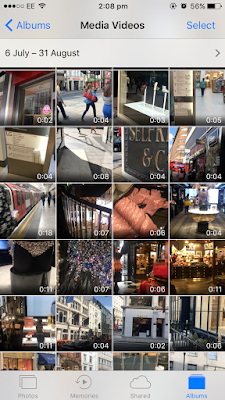
I wanted to film parts of my Documentary in London as it is one of the fashion capitals of the world, this meaning that it is home to lots of designer shops and high end brands which would be perfect for me to film due to the nature of my documentary.
Below you can see where I have organised a date to go up to London with a friend in order to film in this location, also you can see my planning of how to get from one street to another whilst in London.


Below you can see where I have organised a date to go up to London with a friend in order to film in this location, also you can see my planning of how to get from one street to another whilst in London.


Wednesday, 6 September 2017


RESEARCH: Minimalist Subculture
My target demographic tends to fall into the minimalist fashion subculture, this is a category where fashion is stripped down to its most fundamental features but whilst keeping a chic and high-fashion style and flare. As I was researching into this subculture I found an interesting article on the subculture and on how there is a current rise in sustainable and accessible high fashion. See this link here.

Tuesday, 5 September 2017
RESEARCH: Shots in 1 Minute of a Documentary
Whilst researching for my documentary I wanted to know how many shots I will roughly need to fill my 5 minute extract. To do this I looked at a fashion documentary and I counted how many different shots were in the first minute (0-1) the 31st minute (31-32) and the 55th minute (55-56). Here is what I found...
Minute 1 - 30 shots
Minute 31 - 22 shots
Minute 55 - 11 shots
I found that there were different amounts of shots in these different minute due to what part of the documentary it was. The first minute had the most shots as it was the opening and it was setting the scene for what the whole documentary was going to be about. Minute 31 had slightly less as it started to get into an informal interview so less shots were used, and finally minute 55 only had 11 shots as it was a formal sit-down interview so it was more focused on the interview than using lots of different shots.
See the video below for the documentary I used for this research:
RESEARCH: Generic Conventions found from my Textual Analyses
Generic Conventions Found in Fashion Documentaries
1) Interviews used - 4/5 interviews in a whole documentary, 1/2 interviews used within a 5 minute extract.
2) A title screen used with the same font then used throughout the documentary
3) A variety of shots used - medium, long, close etc.
4) Location shots used
5) Voiceovers or Dialogue used
6) Background music used - usually no lyrics
7) Shots of shop signs and shop windows
Links to my textual Analyses:
Monday, 4 September 2017
Sunday, 3 September 2017
Friday, 1 September 2017
Tuesday, 29 August 2017


Wednesday, 16 August 2017
RESEARCH: Audience Feedback on my Treatment
I decided to get some feedback from my focus group to see what they thought of my idea for the documentary. I asked them to write a short statement each about what they thought of the idea, here is what they said:
"I thought it was a really good idea to compare high-street to designer shops, it is a very interesting subject and I would love to watch a documentary about this!" -Connie Davies
"I love the idea of filming in London and Paris, it will make the documentary more interesting seeing two locations' -Imogen Painter
"I think it is really clever and interesting to include the psychological side of why people wear designer brands as it isn't only focusing on the superficial reasons" -Lydia Cassettari
"I would love to watch this documentary, the strong fashion element combined with the psychology behind the decisions we make works really well together!" -Storm Baron
Monday, 14 August 2017
Thursday, 10 August 2017
RESEARCH: Target Audience Questionnaire
I created a questionnaire for my target audience to find out what type of documentary they would be most interested in. Below you can see what questions I asked:


Below you can now see the results of my questionnaire:


I found that for my target demographic a Fashion and retail documentary would be of most interest to them, therefore meaning I will base my documentary around this. I also found out what they would like to see included into my documentary and so I will ensure I use these ideas.
Monday, 10 July 2017
RESEARCH: Focus Group
Name: Connie Davies
Age: 19
Hobbies/Interests: Dancing - Ballet, Modern and Jazz, Fashion - Trends in clothing, enjoys shopping
Access to Documentaries: She has a TV which has Sky broadband, this allows her to watch channels such as BBC2, E4, Channel 5 and more which frequently host a range of documentaries.

Name: Imogen Painter
Age: 22
Hobbies/Interests: She enjoys shopping and is very interested in high-fashion and designer clothing, she also likes to read Elle magazine.
Access to Documentaries: She has a subscription to a Netflix account where she has access to various documentaries. She also has Virgin broadband on her TV which allows her to watch more documentary channels.

Age: 26
Hobbies/Interests: She enjoys going out and has an active social life. She also enjoys online shopping and meeting her friends.
Access to Documentaries: She has a TV which has Sky broadband which gives her access to many channels which feature a variety of different documentaries. She also has an Apple TV box which gives her even more access to a range of documentaries.

Name: Storm Baron
Age: 21
Hobbies/Interests: Going out to see her friends and finding new outfits and clothes to go out wearing. She also enjoys looking at fashion magazines and trying out new makeup looks.
Access to Documentaries: She has a TV which allows her to watch Chnnel 5 and BBC2 which feature many documentaries.
Friday, 7 July 2017


Monday, 3 July 2017
Friday, 23 June 2017
RESEARCH: Documentary Theorists
Bill Nichols
*An American film critic and theoretician.
*Most known for being the founder of the contemporary study of documentary film.
*He wrote a book published in 1991 called 'Representing Reality: Issues and Concepts in Documentary'. This book applied modern film theory to the study of documentary film.
*In Nichols schema he identifies 6 documentary 'modes'; poetic, expository, performative, participatory, observational and reflexive.
*He offered a conceptual framework for the production and study of documentary film.
John Grierson
*A school headmaster who studied Philosophy at University.
*He began filmmaking due to a post-graduate study in the US.
*Grierson created a documentary called 'Creative Treatment of Actuality'.
*He had a great influence on factual filmmaking, he established the National Film Board of Canada. He was also UNESCO's first Director of mass communications and public information.
*Finally, throughout his career he he produced over 1000 film and TV programmes.
Wednesday, 21 June 2017
RESEARCH: Fashion Documentaries
Fashion Documentary Inspiration:
Below is a screenshot of a list of the best fashion documentaries according to Vogue Magazine, to go to this link click here. I found this very helpful as I was then able to go on to look at different fashion documentaries and how they were filmed to gain inspiration for my own.

I have also found a documentary which goes inside British vogue, this showed an exclusive insight to one of the leading fashion magazines in the world. I found inspiration from this as it is the kind of exclusive information i would like to include in my own documentary. Click here to go to the documentary.

Tuesday, 20 June 2017
RESEARCH: Initial Ideas
Some initial ideas for my project are:
- A documentary on Fashion
- In London and Paris
- A documentary on Modelling
- Agencies in London
- A documentary on a part of psychology, for example:
- Conformity - 'Why British people queue'
- Why people are attracted to each other
Subscribe to:
Posts (Atom)
-
 Questions I asked in my audience feedback for the 1st draft of my documentary: Responses I gained from my audience: ...
-
Whilst editing my footage I wanted to look at different possible transitions between cuts which would look best and would suit the pace and ...
-
 For the final draft of my newspaper advertisement I wanted to get some more audience feedback to ensure that it has met all the needs and s...